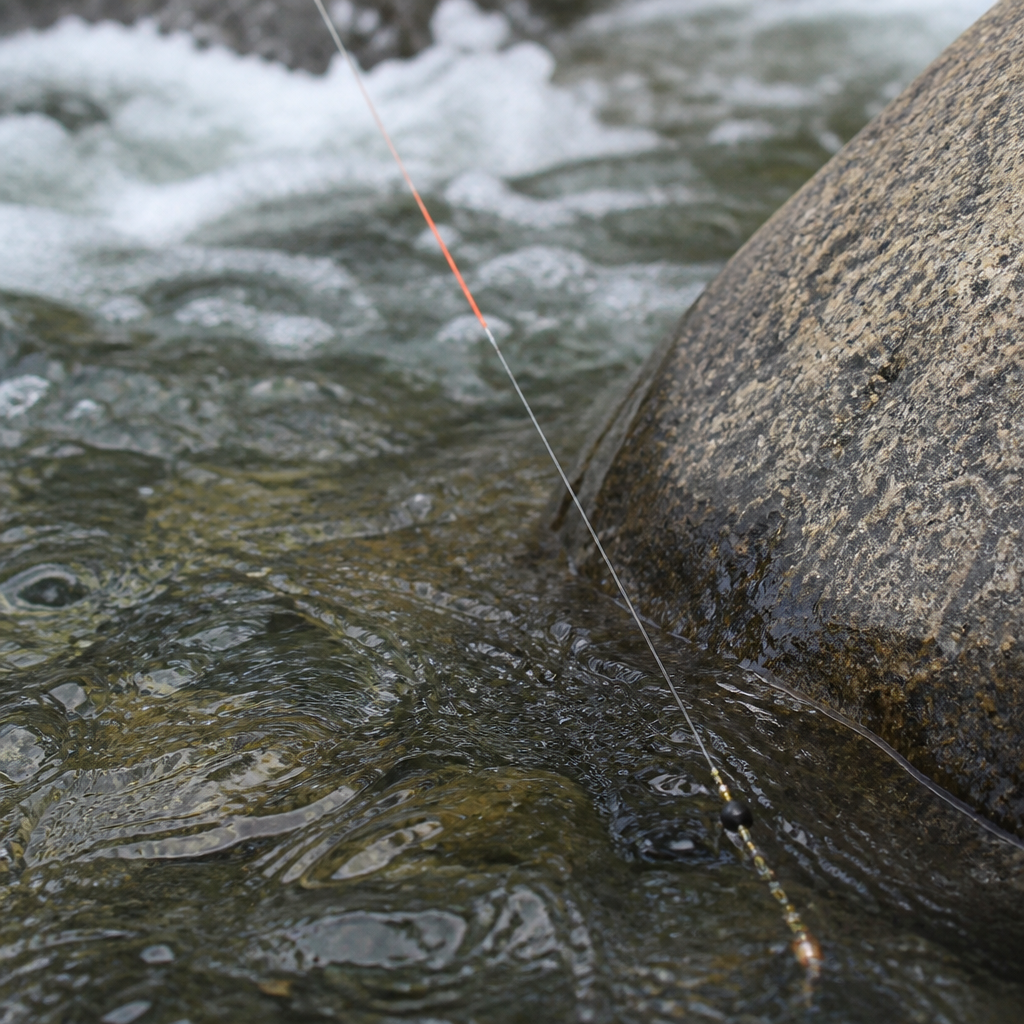
In short
Fish upstream and close, with no more than a rod length and a half of line beyond the tip. Use enough weight to touch bottom occasionally. Track the flies through one seam at a time with the rod high and the line largely off the water, and lift at any hesitation. Then take one step and do it again.
On this page
Why short line works here
Fast water is not one current, it is dozens of currents at different speeds stacked next to each other. Every metre of fly line lying on that surface is dragged at a different rate, and the fly is pulled unnaturally within a second. A long cast in pocket water produces a long bad drift.
Keeping the line off the water removes the problem. With the rod held high and only the leader in contact with the river, the flies travel at the speed of the water they are actually in, which is what a trout is expecting to see.
The rig
Two variants cover almost everything on this river.
| Indicator rig | Tight line rig | |
|---|---|---|
| Rod | 9 ft, 5 weight | 10 ft, 3 or 4 weight |
| Leader | 9 ft tapered to 4X, with a small indicator set at roughly twice the water depth | Long level or lightly tapered leader, coloured sighter section, no indicator |
| Flies | Heavy point fly, lighter dropper 18 in above | Heavy point fly, lighter dropper 18 in above |
| Best in | Deeper pools, longer runs, windy days | Pocket water, close range, precise seams |
| Weakness | Hard to control across mixed currents | Limited to about a rod length and a half of range |
Both use the same flies, taken from the box described on the best flies page. Neither needs anything complicated.
Getting the weight right
There is one rule and it is not negotiable: if you never touch the bottom, you are not deep enough. Contact should be occasional, a tick every few drifts, not constant. Constant contact means you are dragging and will foul.
Adjust weight before you adjust flies. On a river that changes depth every three metres, that means changing weight several times an hour, which is why a small selection of non lead shot in the pocket is more useful than another fly box.
The drift, step by step
- Stand below and to the side of the seam you want. Close enough to reach it with the rod tip and a short leader, far enough not to be standing in it.
- Flick the flies upstream to the top of the seam, no false casting, just a lob.
- Lift the rod as the flies come toward you, keeping the line off the surface and a gentle tension in the leader without pulling the flies.
- Follow with the rod tip at the speed of the current until the flies are level with you.
- Lower and let them swing for a second at the end. Fish take on the swing more often than anyone expects.
- Repeat two or three times, then move. If a seam holds a willing fish, it will show in three drifts.
Distance covered is not the goal. A hundred metres of bank, properly dissected, is a full and productive morning.
Strike detection
Takes in fast, cold water are subtle. The fish intercepts the fly, realises it is wrong and ejects it, often within a fraction of a second. You are not looking for a pull, you are looking for a change: the leader stops, hesitates, moves sideways, or speeds up slightly. Any of those is a reason to lift.
The correct response is a smooth lift of the rod, not a strike. A hard strike in a short line rig breaks tippet and, on the occasions when it does connect, tears hooks out. Lift, feel, and if there is weight, keep lifting.
Four faults that cost fish
- Too much line out. If your fly line is lying across three currents, the drift is already ruined. Shorten.
- Too little weight. The commonest fault by a distance, and the easiest to fix.
- Standing in the fish. The water within two metres of your boots in pocket water holds trout. Fish it before you wade through it.
- Fishing the same seam ten times. Three drifts, then move. Coverage of many good seams beats perfection on one.
Translating this to the McCloud
The McCloud rewards the same discipline with longer, deeper drifts and more weight. The runs are bigger, the walk between them is longer, and the fish are fewer and larger, so patience per spot goes up while the number of spots per day goes down. The character of that river is described in the techniques section, and its water is explained on the flow and clarity page.